
Travel Tuesday – Stonehenge

If you’re like me, you’ve got a list of places you’d like to see sometime in your life — Grand Canyon, Mt. Rushmore, Great Wall of China, etc. and possibly also Stonehenge.

Well, I’m so happy I could take Stonehenge off the list because we took a tour to see it during our visit to London. It took about an hour and a half to get there, but it was worth the trip since we got to see the English countryside and then went on to see Bath (more on that in another post).

Some interesting things about Stonehenge. The word “henge” derives from either “hanging” or “hinge” which makes sense considering how the stones hang on each other.

Even before Stonehenge was built, the area was used as a burial place and there are several burial mounds in and around Stonehenge. Eventually, the closer you got to be buried next to the stones, the more important you were. In this shot from the bus (a little blurry), you can see a burial mound off to the right of the photo. The mounds are known as barrows.

It’s believed that construction at this site began around 3100 BC and continued until about 1600 BC. Archaelogists believe the site was constructed as a monument by early civilizations and the connection to Druids apparently comes much later in the history of the monument.

This shot was taken from what is known as the “Heelstone” (which you can see in the album as the one lone stone apart from the monument). The smaller stone laying down in front is the “slaughter stone.”

Sadly, you can no longer touch the stones or get very close to them. It would have been nice to get in the center and see what kind of energy, if any, exists there. Unfortunately, that was not possible and so the only thing we felt was the cold wind blowing along the fields.

Here are some more photos for you! If you can’t see the slideshow below, you can also click on this link for pictures of Stonehenge:
http://www.facebook.com/album.php?aid=2057499&id=1130005412&l=e7e3468533

For more information on Stonehenge, you can visit:

http://en.wikipedia.org/wiki/Stonehenge
Unesco Stonehenge World Heritage Site
English Heritage Site

Keeping Journals

Journals are a wonderful way to keep track of so many things. Whether it’s a diet journal where you keep track of the foods you eat, a workout journal to record progress, a personal journal for important thoughts or a travel journal to remind you of where you have been, journals rock!

So what’s the best way to keep a journal?

    Like everything else, different things work best for different people. I’m a computer person, so for a lot of my things – like my travels for research – I jot down notes on my computer and upload the photos I take. But I also hang onto the tickets and pamphlets from the various places we go. My daughter and I will then often sit down and create a scrapbook for our trip to retain the memories for the future.

    My daughter is very hands-on, so she keeps a paper journal with her where she writes down her thoughts and stories and adds pictures and other keepsakes.

    Many writers keep journals of their personal thoughts or of ideas for new books. Some do it on paper, others on computers. Some even do it online via their blogs or websites. You can use blog sites to keep online journals, just make sure of two things:

    • If you want to keep it personal, make sure there is a way to set the blog as being private and not public.
    • Make sure there is a way to download or copy that journal to your hard drive or move it to another blog platform.

How often should you keep journal entries?

    Again there is no right or wrong to it, except maybe one wrong – Not doing it.

    Find the best time for you to collect your thoughts or the information you want to record. It may be private time or it may be out in public. At the gym I see a number of people with note pads to track their workout progress. They record the weight and repetitions that they do in order to have an effective exercise routine.

What do I get out of journaling?

    As a writer, you build your writing chops with each writing exercise that you do.

    Plus, it’s a way to keep track of important events or memories that might be lost if they are not recorded in any way. Many years ago I wrote down the history of how my family had come here for my nephew and it was amazing how much there was that he didn’t know and how much I had never really discussed with anyone. I thought it would only be a few pages when I got started and it ended up being more like 20. And that was just general information about the short two year stretch around when we left Cuba!

    If you have a family elder that is still alive, it may be a good time to see about making a video journal of them with some of the stories of when they were younger. There are so many differences from then to now and in the future, all those stories and memories might be lost if don’t record them or if you don’t repeat those stories to the next generation.

I hope you enjoyed today’s Tuesday Tip!

Mexican Recipes from SINS OF THE FLESH

Mexican FlagI’ve had the pleasure of visiting Mexico on several occasions for business and totally enjoyed the time I spent there. The people are warm and gracious, the margaritas are refreshing and the food . . . Well, the food is divine. I could probably eat Mexican food every day and not complain!
My experience with Mexican culture and the many Mexican-Americans in the Jersey Shore area is what led me to make the hero of SINS OF THE FLESH, Mick Carrera, a Mexican-American. As for the heroine, she is Mexican-Irish, a nod to my editor at Grand Central Publishing as well as to two cultures rich in the arts.

There are a number of scenes in SINS OF THE FLESH where the characters are enjoying Mexican food prepared by Mick’s mother at his family’s Mexican restaurant. I’ve shared some Mexican/Tex-Mex recipes with you in the past.

There was my ever popular party food – the layered Tex-Mex dip. You can get the recipe for that Tex-Mex dip, by clicking here.

Or you can try some wonderful nutty and buttery Mexican Christmas Cookies by clicking here.

My friends at Cuervo, who are celebrating their 250th anniversary, have a mess of great margarita recipes at their site. You can check out the Cuervo Margarita recipes by clicking on this link.

But now, another recipe for one of the foods that you’ll see in SINS OF THE FLESH and it’s a simple one. While I love enchiladas and tamales, they are a lot of work. This is an easy recipe and one which you can use for your next party or as a side dish to your tacos, burritos or even as a topping on your hamburger.

Guacamole

  • Ingredients
    • 2 ripe Florida Avocados (or 4 ripe Hass Avocados)
      Juice of two limes (about 1/4 cup)
      1 teaspoon ground cumin
      2-4 shots Cholula or Tabasco hot sauce (to your taste or omit if you do not like spicy)
      2 tablespoons olive oil
      1 tablespoon chopped fresh cilantro
      1/2 cup medium onion finely chopped
      1 clove garlic finely minced
      Optional:
      2 ripe Roma Tomatoes, chopped
      1/2 cup queso fresco, crumbled
  • Directions
    • Slice the avocados in half and remove the seed. Scoop out the insides of 3/4 of the avocados. Leave 1/4 to the side for now.
      Mash the avocados with a fork and add the lime juice and remaining ingredients. Mix together.
      Chop the remaining 1/4 avocado into small pieces and add to your mixture. If you’ve chosen to add the tomatoes and queso fresco, add the tomatoes now and 1/4 cup of the queso fresco.
      Mix all the ingredients lightly. Garnish with the remaining queso fresco.

I hope you’ve enjoyed today’s Tuesday Tip. Just to make it all clear and legal, Cuervo is one of my clients, but I’m recommending their products because they make a wonderful tequila! FYI – If you ever have a chance to visit the city of Tequila in Mexico, see if you can spend some time at Mundo Cuervo, a cultural center established by Jose Cuervo and dedicated to Mexico and the history of tequila. I’ve been there and it is absolutely amazing!

Green Bean Casserole

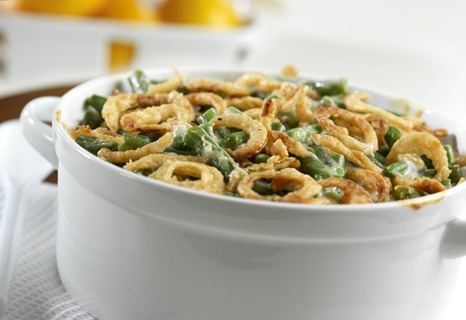
Courtesy Campbell's Kitchen Used under Fair Use ProvisionsWith the holidays here, this is one of my favorite dishes to put on the table! Yep, it’s the classic green bean casserole. My sister gave me an alternate recipe to use this Thanksgiving which was really tasty, but I also like this creamier traditional recipe, but with a little kick of course!

For the Campbell’s Traditional Green Bean Casserole recipe, you can click here. But why not try this variation on the classic!

Ingredients:

    1 medium onion chopped
    2 cloves garlic minced
    4 tablespoons butter
    4 cups cooked green beans (frozen or fresh work best)
    1 can Campbell’s Cream of Mushroom soup
    1/2 cup milk (or for an even creamier taste substitute half and half)
    1 to 2 cups French’s Cheddar Cheese Fried Onions
    1 cup parmesan cheese grated
    1 cup grated cheddar cheese

Directions:

  • Preheat oven to 350 degrees.
  • If using fresh green beans, wash and cut into 2 inch pieces.
  • Steam/Microwave green beans until just tender. Set aside to cool in a large mixing bowl.
  • Saute onion and garlic in the butter over low heat until they are caramelized.
  • Add 1/2 cup milk/half & half and scrape all the brown bits off the bottom of the pan (this is much easier to do if you are using a non-stick pan.)
  • Add mushroom soup mix and stir until creamy.
  • Add onion/mushroom soup mixture to the green beans and toss. Then add 3/4 cups of both the parmesan and cheddar cheeses and toss. Also add about 1/2 cup of the French’s Fried Onions and toss.
  • Lightly grease 2 quart casserole dish. Place green bean mixture into casserole and top with the remaining French’s Fried Onions, parmesan and cheddar cheeses.
  • Bake in 350 degree oven for about 30 minutes or until bubbly.

For another variation, fry up some chopped red peppers and add to the mixture!

Publishing Definitions

There has been a lot discussion during the last week about the new Harlequin Horizons venture. For more on this venture and the response to it, you can click below on these links for comments:

    Ashley Grayson Agency
    Jackie Kessler (Hilarious by the way!)
    Dear Author
    Harlequin and Author Solutions Press Release
    SFWA Statement
    MWA Statement
    RWA Alert to Members
    Harlequin CEO Donna Hayes responds to RWA

In many of the above discussions, there has oftentimes been a use of the terms e-publishing, self-publishing and vanity/subsidy publishing interchangeably, but there are vast differences between those three types of publishing. In light of this, it seems as good a time as any on this Tuesday Tip blog to distinguish between e-publishing, self-publishing and vanity/subsidy publishing.

E-publishing

    With e-publishing there is no monetary outlay of funds by the author. The e-publisher will do editing, create the cover and arrange for distribution of the book through their various channels. The author does not typically get an advance as is done with traditional print publishing, but will receive a royalty based on sales, usually in the neighborhood 25%-35% of either the cover or net price. The e-publishing model shares the reward between the author and the publisher, but the risk is borne by the publisher.

    Oftentimes e-publishing will allow for books that don’t fit a niche to find a home and it has proved financially sound and rewarding for some publishers and houses.

Self-publishing

    With self-publishing, the author will pay for the printing of the book and any related design services (such as the artwork on the cover). The author will own the ISBN, copyright and be responsible for marketing, distribution and sales. The author usually keeps 100% of the sales made, so all risk and reward is with the author. Self-publishing is a riskier move. Many bookstores will not stock self-published books. While there have been some success stories (such as The Shack and The Celestine Prophecy), for every one of those success stories, I suspect there are thousands of tales about books sitting in garages or the trunks of cars. According Bowker, although more ISBNS were handed out for self-published books than for traditionally published books in 2008, the average self-published book sells less than 100 copies.

Vanity/Subsidy Publishing

    With vanity/subsidy, the author pays for “publication” of the book as contrasted to the printing and design of the book. For the fee, the vanity/subsidy publisher will provide X number of copies of the book as well as suggest marketing, editing and other services in order to achieve “publication” and make sales. In addition, the publisher may also retain a portion of the sales for offering the book through their distribution channels. For example, you may pay $600 for the basic vanity publishing package, but you may also need to pony up 50% of the either the cover or net price of each sale to the publisher. Therefore, you will only receive 50% of the cover/net price as a royalty. Please remember that the net price could be substantially less than the cover price, drastically reducing your “royalty.” For example, Amazon takes approximately 35% of the cover price as its share for listing the book, so as an author, you would only receive 50% of the 65% left from the cover price. In the vanity/subsidy publishing model, 100% of the risk is borne by the author but not 100% of the reward.

So what is an aspiring author to do? There is a difference between being published and being in print that is being blurred by today’s print on demand technology and the advent of the Internet. For starters, remember the first rule: Money should flow from the publisher to the author. Then, remember the second rule: If anyone asks you to outlay money to publish your book, seriously reconsider that “publication.” There is a reason why AAR and other organizations have a code of ethics that prohibits literary agencies from charging fees to aspiring writers. As a writer, you should consider applying that rule to any publishers that you are about to consider.

Fall into Autumn Color

mumWoke up to a brrr in the air. There’s no doubt that fall is here, but that doesn’t mean the end of color in your garden.

Best bet – Hardy mums! Treat them right and they’ll survive the winter and come back for more fall foilage next year. Plus, there is such a wide range of colors to brighten a possibly dreary autumn day.

If you’re going to cut the mums as a gift, just be careful to whom you present them. In some cultures, Latins and Italians, the mum is known as the “Flower of the dead” and is typically not presented to someone as a bouquet.

Next best bet – flowering kale. Fill your borders and other low-lying areas with colorful kale in deep purples with bright white centers or totally white ornamental kale.

Another good bet is one of my favorite flowers – pansies/violas. They’ll survive a mild frost and violas are perennials, so look for them to return next year. Also, pansies are excellect reseeders, so don’t be surprised to see them coming up in the early spring as soon as it starts to get warmer.

Last but not least, colorful asters will provide awesome fall blooms and better yet, they’re perennials so they’ll be back next year for more color.

Hope you enjoyed today’s Tuesday Tip! What are your favorite fall flowers?

Ripe Plantains and Behind the Scenes of SINS OF THE FLESH

Mexican Food RecipeWhen I was researching SINS OF THE FLESH, I wanted to make sure that I gave readers a taste of the characters in a variety of ways, including in the foods that they would eat. Since my research revealed a large Mexican population down the shore as well as in towns like Freehold, it seemed that my mercenary and ex-Army Ranger hero, Mick Carrera, would be Mexican.

And since I love books with foods/chefs (THE PERFECT MIX, SEX AND THE SOUTH BEACH CHICAS and MORE THAN A MISSION), it only seemed right that after Mick’s family had legally immigrated to the United States, they would succeed in their American Dream by opening a Mexican restaurant in one of the shore towns.

But Mexican food is more than tacos and burritos or the Tex-Mex dip recipe I gave you so long ago. I’ve been lucky to visit Mexico City, Tequila and Guadalajara on various occasions and sample the amazing dishes available in those cities (as well as the margaritas!).

But today’s Tuesday Tip comes courtesy of a visit that my daughter paid to a local Mexican restaurant in Philadelphia. She made the dish for us and it was delicious. Plus, it’s simple and incredibly tasty. What could be better? So here is today’s Tuesday Tip Recipe:

Ingredients:

  • ripe plantains (2) or 2 packages of Goya Frozen Ripe Plantains
  • sour cream
  • queso fresco
  • chopped chives

Directions:

  • 1. Most stores carry plantains, but they must be ripe for this recipe. That means they should have a deep yellow/spotted black outer skin so they will be sweet. Getting them perfectly ripe can be hard, which is why I cheat and rely on the Goya Frozen Ripe Plantains. Always ripe, no peeling and lots of sweet.
  • 2. If you’re using fresh plantains, peel them. Cut diagonally into ovalish slices. Alternative – open the Goya box.
  • 3. Fry up the plantains, either in vegetable oil or butter. This is one time not to use virgin olive oil because it will overpower the sweetness factor. Cook until golden and caramelized.
  • 4. Place the fried plantains on a slightly greased serving dish (They are so sugary, they will stick!).
  • 5. Garnish with sour cream, some crumbled queso fresco (available in the dairy section) and the chopped chives.
  • 6. Serve. This recipe will comfortably provide a side dish or appetizer for 4 to 5 people.

Hope you enjoyed today’s Behind the Scenes look and Tuesday Tip recipe!