Writer’s Block

wallIt’s not often that I get Writer’s Block, but it does happen on occasion. Often times it’s because I’m wrestling with which way the story should go and not happy with any of the directions which are coming to me.

When I hit that wall, I do wish there was this big red door that I could open to break through, but sometimes the best way is to not keep butting your head up against the wall. Sometimes the best way is to take a step back and take another look at the wall so you not only see the door, but now who to open it.

How do you do that?

1. Pick up a good book to read. I would recommend that it even be something different from what you are trying to write. Reading other genres, and interacting with writers from other genres, is a good way to see the same problem in a different light.

2. Watch a good movie. Again, preferably one that’s different from what you’re writing. Same idea only it takes less time if you’re as impatient as I am. Also, some people need more visual stimuli to see the big red door.

3. Listen to music. I’ve been inspired more than once by a song lyric that’s allowed me to tackle the story with a different perspective or a revitalized concept of the conflicts.

4. Try writing something new. Sometimes you get just too involved in a story or you’ve looked at it one too many times. Refreshen yourself by trying out a new story line or concept.

5. Take a nice long hot shower and while you’re at it, consider the problem in your story that’s creating the boondoggle. Something about putting showers and thinking together always seems to yield good results.

6. Take a walk or do some exercise. Again, think about your story and see if getting out into the fresh air or taxing those muscles produces some new ideas.

I hope those little tips help you find the way through the wall created by your writer’s block!

Also, remember that you have until midnight EST March 25 to visit my friend Kaye Monro for a chance to win a SINS OF THE FLESH T-shirt and a copy of SOLDIER’S SECRET CHILD!

Just click here or visit this link: http://kayemanro.blogspot.com/

Look for two more opportunities soon to win some prizes in my HONOR CALLS/FURY CALLS b’day bash continuation!

The Dreaded Info Dump

dumpI was rewriting a chapter yesterday and when I read it to my critique group, I didn’t need them to tell me what I was doing wrong.

I knew I was doing the Dreaded Info Dump.

What’s that? you might ask.

Well, if you’re a reader it’s something you hopefully will not see in a book. It goes something like this:

Mary realized that it was Dr. Smith. He had treated her for bunions three years ago. Then again two years later for a heel spur. Now she was there to see him for an ingrown nail, but suspected it was much more than that. For two weeks her toe had been hurting. It had first been a slightly pink color. Then a few days later a little brighter red. Then after a week it had started getting really nasty. Finally a day ago she realized it was time to go see her favorite foot doctor.

Yes, I know we wouldn’t be interested in a story about her feet, but imagine that the story was a romantic suspense and all that information was about what had happened to the heroine in the last three months – an info dump.

Much like the person in the photo I posted, info dumps inundate a reader with too much info at one shot and in general, are boring. It’s like reading an encyclopedia entry for your hero or heroine.

If you need to provide the reader some backstory, it should be layered throughout the chapter and provide subtle hints and information about what’s put the protagonists in their current situation. In fact, the less you say and make the reader intuit, the more they will be drawn into the story you are writing because the reader is participating in the story.

Of course, don’t make it so confusing or obtuse that the reader will say, “I just don’t get it,” and disengage from the story.

The hints should be clear and lead the reader toward an understanding of what’s happening. They should be like the breadcrumbs that Hansel and Gretel leave behind, enough so they can be followed to a particular point where you, the writer, are leading them.

How do you know you are doing the dreaded info dump as a writer? Look for long paragraphs filled with too much information. Dense paragraphs like that are a clear sign that something is up that you should revisit.

I hope you found this Tuesday Tip helpful.

Also, don’t forget this week’s b’day bash. Just visit any of the blogs listed below this week and leave a comment and you’ll be eligible to win a prize from me! At Barbara Vey’s blog, there are tons of other prizes as well!

I’ll be visiting all of these blogs and if you’ve left a comment at any of them, you’ll also be eligible to win a $25 Godiva gift card! The more times I see your name at the different blogs, the more your chances improve to win the gift card. So take a moment and stop by one or all to improve your chances of winning a prize.

The contest ends on Friday, March 13th at midnight EST, so be sure to get your comments in there on time!

Barbara Vey’s Beyond Her Book Blog for lots of fun and giveaways!
http://www.publishersweekly.com/blog/880000288/post/1240041524.html

Fresh Fiction: http://freshfiction.com/page.php?id=1602

Harlequin Paranormal Romance blog: http://paranormalromanceblog.wordpress.com/

Liberty States Fiction Writers (leave a comment on any of the blog posts): http://www.libertystatesfictionwriters.com/blog-read-around-the-world/

Long and Short Reviews: http://longandshortarchives.blogspot.com/search/label/Caridad%20Pineiro

To Tweet or not to Tweet . . .

Tweet Tweet!To tweet or not to tweet, that is the question. Some of you may be wondering just what a tweet is. A tweet is a post using Twitter.

So now some of you may wondering, What’s Twitter? Wikipedia defines Twitter as “a social networking and micro-blogging service that allows its users to send and read other users’ updates (known as tweets), which are text-based posts of up to 140 characters in length. Updates are displayed on the user’s profile page and delivered to other users who have signed up to receive them. ”

Lots of people are sending tweets. Some believe it is a useful way to promote yourself (see this discussion at Bubblecow) and others do not (see West Pier Words).

I’m undecided, although I’m leaning toward the not. Like Dot at West Pier Words, I’ve gone through the Shelfari, Gather, etc. thing only to find they take up too much time. I do have Myspace and Facebook pages. I’ve found them to be good for letting people know about the books and also, connecting with friends from all over. Same goes for this website and blog. It’s nice to hear from you and it does truly make a difference to me!

As for adding yet another thing to my life – my already crowded and busy life – I think I’ll forego the tweets for right now.

How about you? Do you Twitter? Do you find it for keeping up with friends? For those of you who are published authors, do you like it?

Also, a big thanks to my fellow author Chris Redding for the links to the Twitter discussion. You rock, Chris. You also tweet! LOL!

Characters are Plot

writingheartAt the February meeting of the Liberty States Fiction Writers we were very lucky to have my friend and fellow author, Anna DeStefano, do a wonderful workshop on revisions. During the course of the workshop, Anna mentioned something which I truly believe – Characters are plot.

Why do I believe that? You may read a book that has a good plot – pacing works, premise is interesting. But if the characters leave you flat, you will forget that book almost as quickly as you read it.

Writing emotionally developed and interesting characters is, IMHO, key to creating a memorable book and plot. Why plot? you ask. Because it is the development of the characters and how they resolve their internal conflicts that creates the story arc of your plot. It is your job as a writer to craft scenes in which the characters are challenged to deal with their conflicts and advance until at the end of the novel, the characters have resolved those internal conflicts (or maybe just one of them if you are creating a series with the same characters).

For this reason, I totally believe that characters are plot. When you define your characters and how they need to grow, you can then build a story around that. When you do, you will have a book where your readers are always on the edge of their seats wondering whether or not the character will rise up to the occasion or fail. Readers will cheer for them and their hearts will break when the characters encounter problems.

When your readers finish your book, not only will you have given them a story that engaged them, but you will have touched them and created characters they will remember long after the books are sitting on a shelf.

Characters are plot. Remember that before you get started and your story will almost write itself.

Guest Blogging

blog1I’m a firm believer that one of the most effective ways for any writer to spread the word about themselves is via the Internet.

Whether you do it by having a website or blog, doing press releases or video trailers, the Net is the way to get more bang for your buck. Another of those ways is by doing guest blogging on other people’s sites.

How do you go about doing guest blogging? First, build a network of connections. Reach out to friends with blogs or visit blogs that you find interesting and ask them what you need to do to be a guest blogger.

I’ve done that recently and am guest blogging at two sites this week! For those of you who visit those sites and leave a message, you’ll be eligible for a drawing to win a CALLING T-shirt, copy of DESIRE CALLS and SOLDIER’S SECRET CHILD. Just leave a comment at either of these blogs!

http://bronzeword.wordpress.com/ – Just mention Caridad sent you on the blog!

TRC Reading Blogpspot – I’ll be blogging there tomorrow to discuss FURY CALLS, so please drop by and leave a comment.

Sign up with one of the promotion companies that will put together a blog tour for you. I’ve used my friend Dorothy Thompson’s service, PUMP UP YOUR PROMOTIONS, and she does a nice job!

Hope this Tuesday Tip gives you some ideas for your next book promo.

Also — Harlequin is celebrating it’s 60th Anniversary and to do so, it is giving away 16 free books — one from each of its imprints. Click on the icon below to get your free books or visit www.HarlequinCelebrates.com.

Click here for free books!

Plotting Your Novel

Starting to write a novelBefore I sold my first few books, I never had either a synopsis or outline of the story I would write. I would just get started and bam —
Of course, my first book was an unwieldly 1200 pages and needed to be broken into three stories for it to be marketable. I managed to break out the first story, but never sold it. One day I may dust it off and see what to do about it.

Since then, I’ve learned the necessity of having at least the basic elements of the story in my head before I sit down to write the dreaded synopsis. (I so hate writing the synopsis!)

So, before I write, I consider the following three points in the overall story arc:

    1. The ordinary world of both the hero and heroine and what their role is in that ordinary world.
    2. The ending, namely, what I want both the hero and heroine to have learned and accepted about themselves when the story ends.
    3. How I will make them confront their internal conflict at the height of the story (the black moment as it were).

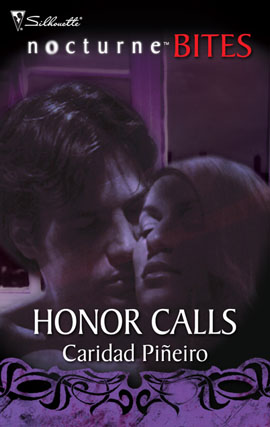
For example, in HONOR CALLS, I knew that the heroine, Michaela, was a loner in her ordinary world and devoted to a cause – hunting the vampire that raped and killed her mother. The hero, Jesus, was also a loner with a devotion to his own cause — the FBI and upholding the law.

What ending did a want? Well in a romance it has to be a happy ending so I knew I had to get them together somehow and they had to have learned something about themselves. In this case that they didn’t necessarily have to be alone for the moment. (I say this because I would really really like to continue this story in a full length novel.)

As for their internal conflict at the height of the story — sorry, I’m going to tease you and say you’ll need to read the story to find out.

With those three basic plot points you can then write the scenes to start your story, know what you have to do to reach the black moment and where you will go once you overcome that obstacle.

For those aspiring writers out there, I hope that this helped! Also, if you’ve got a project and need a jump start to get it going, check out the Liberty States Fiction Writers Mayke It Happen Challenge. (No, that’s not a typo!). The Mayke It Happen Challenge ends in May, hence the MAY in MAYKE.

If you reach your goal by May 31, you will be eligible for a drawing for a critique. Three people will be chosen and either an editor, agent or published author will offer a critique of your work. From now until May 31, you will be on an e-mail loop sharing your progress, asking questions and being mentored by four published authors! The four published authors are:

    Debra Mullins
    Linda Parisi
    Caridad Pineiro
    Lois Winston

For more information on the challenge, you can click here!

HONOR CALLS by Caridad Pineiro February 2009On another note, HONOR CALLS is now available at Eharlequin.com! For more on this novel, you can click here.